Deep, not linear
Deny a 30 to 50 km deep area around each protected asset rather than a line along the border.

Technology
Modern drones and guided bombs are built to resist jamming. That is precisely why range and geometry decide the outcome, not raw transmit power.
Anti-jam receivers
An eight-element array can null seven or eight directions. Reach it from nine or more bearings at once and it runs out of nulls. A sixteen-element array needs eighteen or more.
Network design
Cheap drones carry a basic inertial navigation system. They will coast through a shallow jammed strip, re-acquire GNSS on the far side, correct their track and still hit the target. Denial has to be deep, not linear.
Deny a 30 to 50 km deep area around each protected asset rather than a line along the border.
Sites roughly 14 km apart, positioned so every point inside the zone is reached from enough bearings at once.
Deploy across 125 × 125 km to fully protect a 100 × 100 km area.
| Civilian drones, no CRPA | 4 units cover 120×120 to 160×160 km |
|---|---|
| 8-channel CRPA UAVs | ~50 units, 20 km spacing |
| 16-channel CRPA UAVs | ~100 units, 14 km spacing |
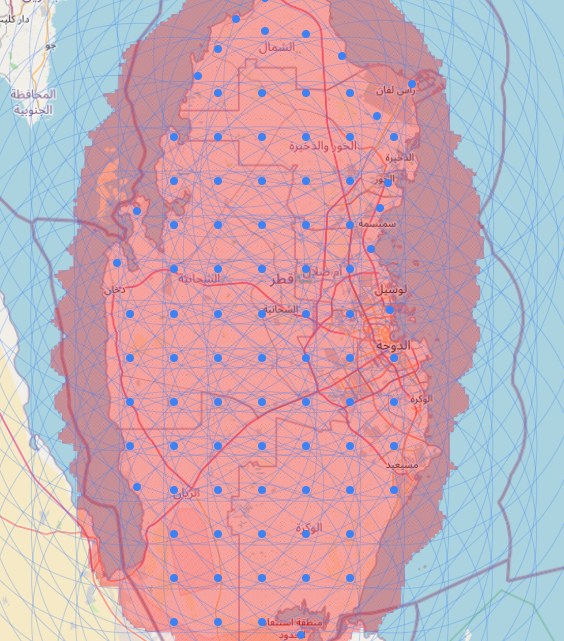
A second worked example: approximately 90 units modelled over Qatar.
Scope
Stated plainly, because an evaluator deserves it: J-05 owns the GNSS-dependent majority. The rest is what the inner layers of a defence are for.
Beyond denial
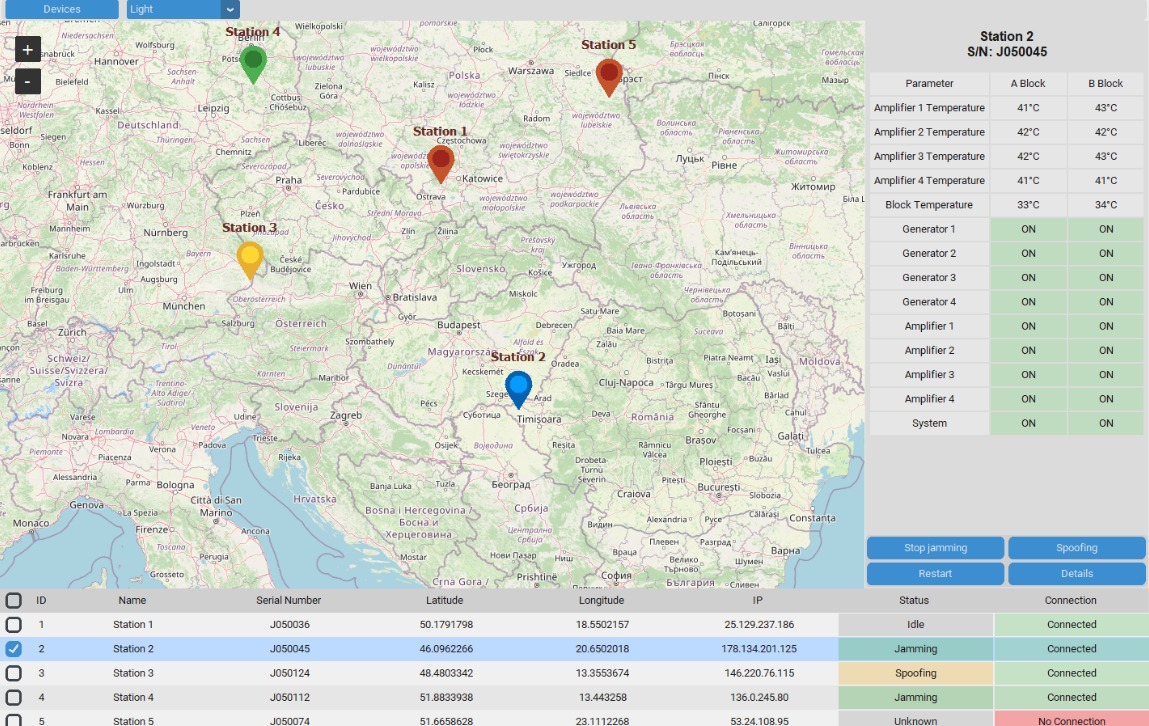
Ephemeris is taken from satellites or from the network. Both jamming and spoofing states are managed from the same console.
Detailed engagement data, test conditions and integration documentation are available to qualified parties under NDA.