Technology

How it works

Modern drones and guided bombs are built to resist jamming. That is precisely why range and geometry decide the outcome, not raw transmit power.

Anti-jam receivers

Defeating CRPA

  • What they are. Controlled-reception-pattern antenna arrays electronically null out jamming that arrives from a fixed direction.
  • In the field today. Eight-element arrays are common on guided bombs and loitering munitions, and sixteen-element arrays are now appearing.
  • The N+1 rule. To deny an eight-element array you must reach it from nine or more different bearings. A sixteen-element array needs eighteen or more.
  • Why that favours range. More bearings per target means long reach wins. One network builds the required overlap with far fewer sites.
ONE BEARING Nulled The array steers a null onto the single source. NINE BEARINGS Saturated More sources than nulls. The fix is lost.

An eight-element array can null seven or eight directions. Reach it from nine or more bearings at once and it runs out of nulls. A sixteen-element array needs eighteen or more.

Network design

Why a border line does not work

Cheap drones carry a basic inertial navigation system. They will coast through a shallow jammed strip, re-acquire GNSS on the far side, correct their track and still hit the target. Denial has to be deep, not linear.

Deep, not linear

Deny a 30 to 50 km deep area around each protected asset rather than a line along the border.

Overlapping fields

Sites roughly 14 km apart, positioned so every point inside the zone is reached from enough bearings at once.

Edge margin

Deploy across 125 × 125 km to fully protect a 100 × 100 km area.

Units to protect 100 × 100 km (10,000 km²)
Civilian drones, no CRPA4 units cover 120×120 to 160×160 km
8-channel CRPA UAVs~50 units, 20 km spacing
16-channel CRPA UAVs~100 units, 14 km spacing
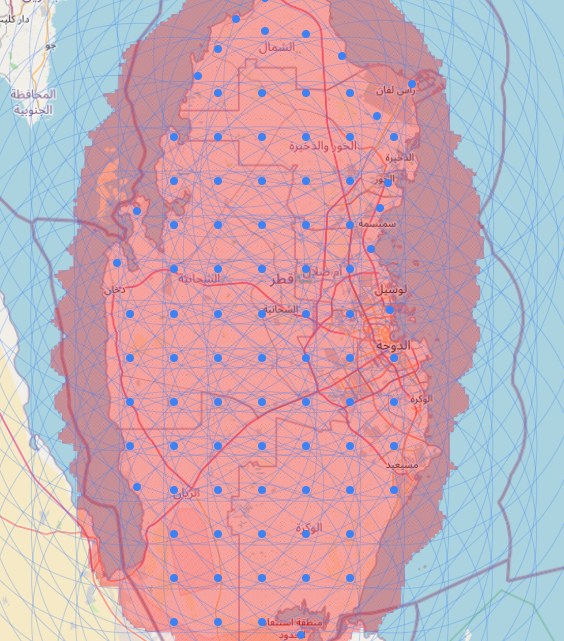
Modelled J-05 coverage footprint over Qatar

A second worked example: approximately 90 units modelled over Qatar.

Scope

Where GNSS denial fits, and where it does not

Stated plainly, because an evaluator deserves it: J-05 owns the GNSS-dependent majority. The rest is what the inner layers of a defence are for.

Defeated or degraded by J-05

  • Mass loitering munitions. The volume threat in any large raid.
  • Glide bombs and standoff missiles. GNSS-guided munitions launched from 100 to 300 km.
  • CRPA anti-jam receivers. Beaten by network geometry rather than brute power.
  • Autonomous mission profiles. Spoofing can redirect or force-land, not merely deny.

Needs another layer

  • Fibre-optic FPV drones. No RF or GNSS link to jam. Tethered and short-ranged, so a close-in problem for directed energy or kinetic.
  • AI and thermal terminal guidance. Jamming still degrades the cruise phase, but the terminal seeker does not need GNSS.
  • Satellite control links. Starlink and Iridium-class links sit outside GNSS bands and need comms-band EW. They buy control, not navigation, at a cost per airframe that prices the attacker out of mass raids.
  • Inertial-only runs. Accuracy decays with distance, so the weapon is degraded rather than denied.
Scope is the point. J-05 removes the mass-raid majority cheaply and across whole regions. What remains is a smaller, shorter-ranged and far costlier set for an attacker to field, which is exactly what the inner layers are sized to handle.

Beyond denial

Spoofing: take control, not just deny

  • Static coordinate. Hold a false fix in place.
  • Static path. A false route with defined elevation and speed.
  • Dynamic path. Live coordinate input to steer a target as the situation develops.
  • Effect. Redirect a hostile UAV mid-mission or force it to land, instead of simply blinding it.
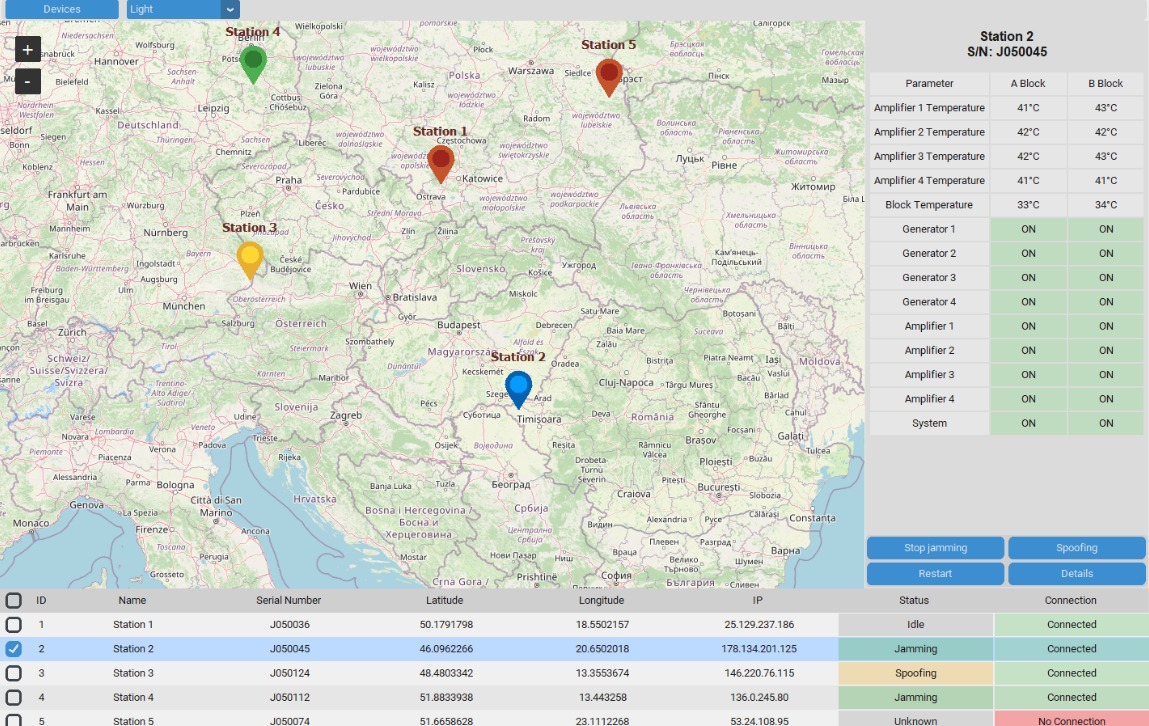
Control software showing spoofing configuration across a station network

Ephemeris is taken from satellites or from the network. Both jamming and spoofing states are managed from the same console.

Technical questions welcome

Detailed engagement data, test conditions and integration documentation are available to qualified parties under NDA.